
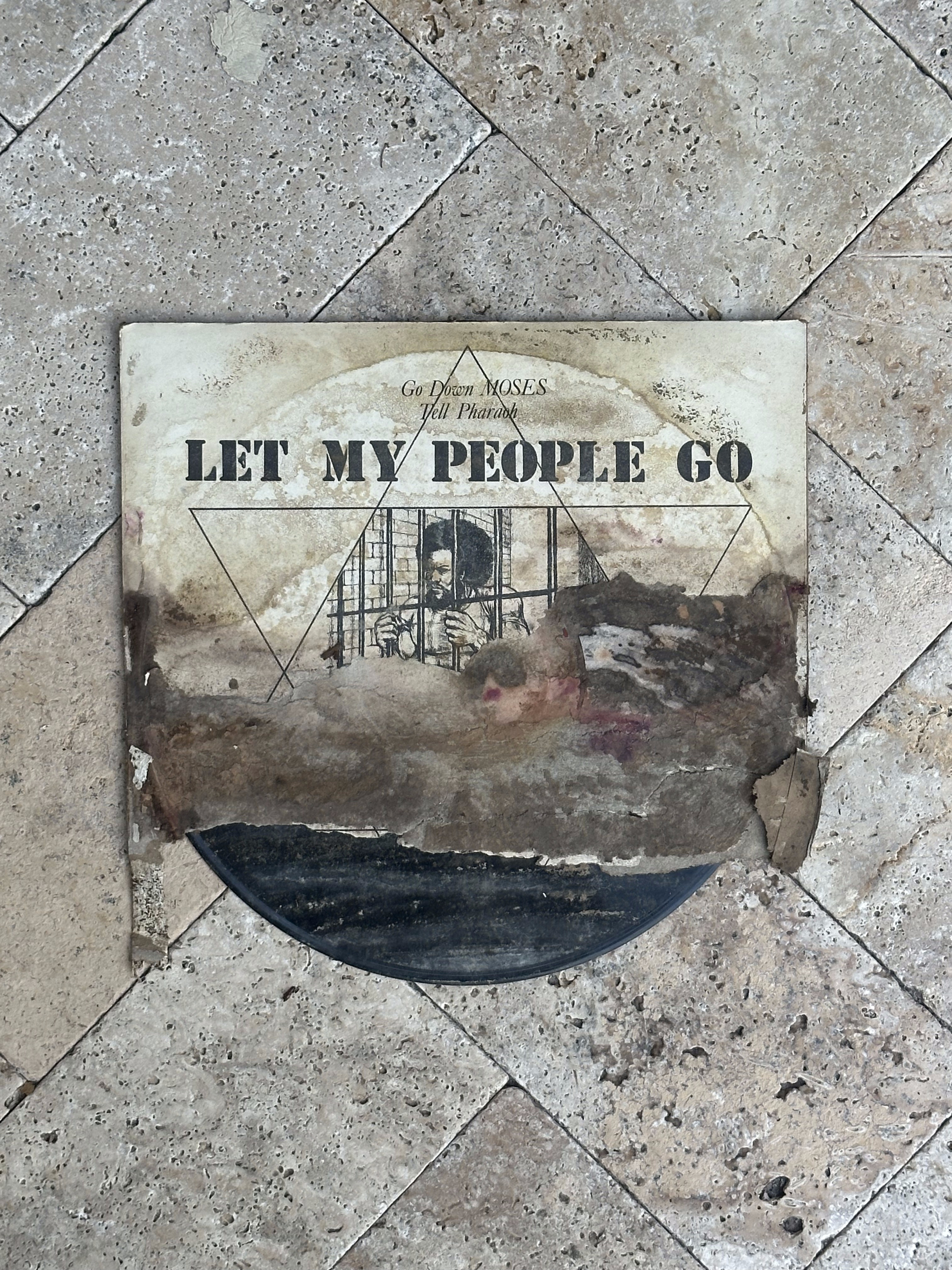
A few days ago, I found this record in a collection of soul and R&B records that unfortunately sat a little too long in someone's storage unit for one too many Miami summers. We managed to salvage a few thangs — a copy of Little Beaver's Black Rhapsody on Cat Records, a kids gospel record with a version of “Love T.K.O” (yeah, that exists), some catalog soul joints for the bins, etc. All in a day's work. I digress, the picture. This actively decaying copy of Let My People Go by Prince Gideon Israel. The cover is barely holding together, South Florida humidity having penetrated most of the sleeve. But the image is still legible: a figure behind bars, a Star of David, “Go Down Moses Tell Pharaoh” printed across the top.
I've found this record a bunch of times over the years digging in South Florida. It was actually pretty common around the city in the early 2000s. When you find something like this, your mind starts roaming. Was the dude who just sold me these records part of the “church”? Or did someone hand it to them as some sort of musical recruitment tool? Like — “Hey man, you like soul music? Check out this record by my buddy who says he's god.”
That is the thing about these records. They were not music in the way we usually mean. Nobody was at the Big Daddy's Lounge running doubles of Prince Gideon. They were tools. But before any of that, there was a family from Dania Beach who made some of the biggest soul hits to come out of South Florida.
Carter and Eddie Cornelius were writing songs in the late 1960s when they answered a talent search ad and ended up in front of producer Bob Archibald, who recorded them at the Music Factory in Miami. They brought their sister Rose in. She had already appeared on The Ed Sullivan Show in 1967 and had been performing in Las Vegas.
By 1971, Cornelius Brothers & Sister Rose had a top-three record on the Billboard Hot 100. “Treat Her Like a Lady” not only went gold but plays every time someone decides to watch the story of the legendary Ron Burgundy. The follow-up, “Too Late to Turn Back Now”, hit number two in 1972 and went gold again. Two top-three singles in two years.
The type of songs you might catch yourself humming along to as they faintly play in supermarket speakers while you cruise the pasta aisle, or dancing to after one too many Manhattans at Greg from IT's wedding. They were worldwide bangers, pressed in massive quantities, and they show up often — albeit looking partied. That said, they represent something real about what was happening not only in South Florida but all over the country: family acts, gospel roots, regional studios, and songs written by local people about universal things.
The group kept charting until 1974, then went quiet. By 1976, it was over. And then everyone went somewhere completely different.
Carter joined a Black Hebrew sect in Miami and took a new name: Prince Gideon Israel. For the next fifteen years, he wrote, recorded, and produced music for the Nation of Yahweh, a religious organization based in Liberty City that, at its peak, had thousands of followers throughout Florida. The leader, who went by Yahweh ben Yahweh, was eventually convicted on conspiracy charges connected to murders carried out by members.
The story is fascinating, and the church emerged and eventually flourished amid the heightened racial tension in Miami at the time — setting up shop in 1979, the same year as the McDuffie incident and six months before the riots.
And in the words of Sly Stone, it was a family affair: Yahweh ben Yahweh was Carter’s first cousin. This was not a movement Carter stumbled into. It was family.
Carter died of a heart attack on November 7, 1991 — the same year the organization collapsed under federal prosecution. A year before his death, he gave an interview to a local news station to promote his album. In it, he speaks directly to the camera, adorned in gold like Paid in Full era Eric B. with a turban and the confidence to match, and says he plans to sell one million copies. The interview plays like a standard music promo. The production is real. He is completely serious. Yahweh ben Yahweh was indicted shortly after.
The video still has active comments. People still believe. Carter clearly poured real craft into this. The music is sorta good and kinda cheesy. The energy is there, though. The intent, well, that was something else entirely.
The music he made during this period was not gospel in the traditional sense. It was early ‘80s soul music: some boogie, some funky soul, all of it lo-fi, all of it made outside any commercial system. The production craft he built over two gold records is still there in every track. But every track is about one thing: praising the leader. The genre is familiar. The content is not.
I played one of those songs on Above the Clouds Radio, Episode 271. It’s definitely the only cult-adjacent tune we’ve run on the show, but hopefully not the last. What it was made for is something else.

Eddie went to Memphis.
Both albums came out in 1982 on Audiograph: My Hands Are Tied and For You. They were recorded at Sounds of Memphis Studio. The Memphis Horns are on My Hands Are Tied. Andrew Love. Ben Cauley. Someone believed in these sessions enough to call in the right musicians.
On both albums, Eddie re-recorded the old group’s songs. “Treat Her Like a Lady.” “Don’t Ever Be Lonely.” “Too Late to Turn Back Now.” The songs he and Carter wrote together. He played them alone in Memphis while his brother was making music in Liberty City for a completely different reason.
Neither album got any real distribution. Both are genuinely rare and I’ve never seen them. These likely never made it out of Memphis. I’m sure some old head local digger has a story about how these “were everywhere in the ’90s.” The good ole days.
Over 500 people on Discogs have them on their want list, and under 100 have found them. For You has cleared $420. My Hands Are Tied has cleared $465. These are not common soul LPs hiding in plain sight. They are the kind of records that make collectors stop flipping.

Frank “Thumbs” Cornelius put out over 10 releases under his own name and has hundreds of production and writing credits throughout the ’80s and ’90s. His stint with 4 Sight Records out of Fort Lauderdale produced the classic electro rap release “Beef Box,” featuring a young M.C. Ade as the “effects coordinator.”
Before his solo album Tender Lover in 1989, he released a string of independent electro-flavored 12” singles. 1984’s “Computer Games” is a vocoder electro 12” on F.H.L. Records, published by something called Happy Stepchild Music — another thread in the Henry Stone story. Computer-themed electro records feel like their own niche micro-genre, but what else are you supposed to sing about when your voice is giving Danger Will Robinson vibes.
Then in 1985 he’s back with the family connection, bringing along his brother Bert — Bertram Cornelius — under the name Frank and Bert. Which would have been a more memorable name if Sesame Street hadn’t already laid stake to half of it. “No One’s Gonna Love You” on Big C Records is lo-fi boogie soul with an infectious hook that should have been on the radio. Alas, like so many small label releases from that time, it disappeared without a trace, only to end up as a coveted relic of a bygone era. Eight people on Discogs have a copy. Three hundred and ninety-two want one. The last known sale was $300.
The consummate family man, in 1990, while he was making his own records, he is credited as bass player and co-producer on Smooth Sailing, a Prince Gideon LP on Hangar 18 Records. Carter’s record. Soul music made inside the movement. Praise songs for the leader. Frank played bass on it. Frank co-produced it. One year before Carter died.
The same hands. The same family. The same Dania Beach.
After the group dissolved, Rose went back to The Music Factory, the same Miami studio where they had made their hits. She recorded two tracks with producer Shirley Cowell, who would later receive a Grammy nomination for her work with Lena Horne. The tracks were arranged by Frank Owens, a gold-certified studio veteran who had played piano on Marlena Shaw’s disco LP. The sessions were good. Nobody cared.
The tapes became an acetate. The acetate went somewhere. For roughly forty years, that was the end of it.
In 2018, a Northern Soul DJ in England named Dave Thorley found the acetate listed for sale online. He bought it, tracked Rose down, and got her permission to release it. A Berlin disco label called Disco Bizarre put it out in 2023, restored by San Francisco disco historian Jim Hopkins and remixed by New York producer DJ Duke. It is a non-stop late-’70s groover, the kind of track that locks in and does not let go — built for a dance floor and arriving fifty years late to one. The original recording is probably from 1978. Rose could not remember exactly.
The record is called Here. It is on Bandcamp. It came out on a label in Germany because a collector in England happened to see an acetate for sale online at the right moment. That is how fragile this history is.
If you are digging through South Florida soul, private press, boogie, electro, or gospel-adjacent records, these are the Cornelius family records worth knowing:
Some are common. Some are nearly impossible. All of them sit somewhere inside the same strange family map.
When a Prince Gideon record turns up in a collection — and they are getting rarer and harder to find — you are not just holding a piece of South Florida soul history. You are holding something that was designed to bring people in. A physical artifact of a recruitment operation. Some of the people who owned these records were members. Some were probably being handed them for the first time as an introduction to something. That is different from any other record in the crate.
The history of this family, this music, and these connections deteriorates if nobody talks about it. The records are falling apart. The acetate that became Here almost disappeared entirely. The copy of Let My People Go that came through our shop is barely holding together. When these things go, they go for good.
The Cornelius family was not the only act coming out of that community. There are rare boogie records from the same area: other Black family acts, independent pressings, and regional releases that barely made it out of South Florida. Dania Beach itself had another notable family act — the Broomfields. That is a different post.
If you have a South Florida record collection and you pull something out of a sleeve that does not match anything you have seen before — a name you cannot place, a label that does not exist anywhere else, a record that looks homemade, local, half-lost — slow down. There is a whole category of records from this region and this era that the databases still have not caught up with.
Found Sound Records is in North Miami. We buy large vinyl collections throughout South Florida and beyond — soul, funk, boogie, disco, gospel, private press, reggae, jazz, Latin, Caribbean, and local Florida records. If you have a collection like this, or if you found something strange in a South Florida record crate, get in touch.